Wednesday, 20 July 2016

8 Tips on Meditation

Meditation is a practice that sits at the heart of Buddhism, but can prove equally beneficial to those of other beliefs. Meditation, at it's most basic form, is just sitting. It's a chance for introspection. An opportunity to gather all your sporadic thoughts from the day and gather them into a neat little basket with a bow on it. We live in a world where everything needs to be done quickly. Social media is constantly buzzing away whether we're awake or asleep and it takes a lot of nerve for us to separate from our mobile phones for more than 3 seconds.

This is why meditation is important. In a world that is constantly on the go we can take refuge in our own little bubble, in our own minds, and take advantage of the serenity and peace that we all have at our disposal. With this in mind, here's a list of my top eight tips for meditating!

  1. Start Small


Trust me when I say, no good will come of you going head first into 3 x 45min sessions of meditation a day. While it most likely would be advantageous, and you'd probably notice straight away how it affects your mindset, dedicating that much time from the off will discourage you from practising consistently. You'll wind up meditating in random spontaneous bursts that will no doubt fizzle out after a few weeks.

You're much better off starting with 2-5 minutes in the morning (or evening, or both!) and working your way up week by week until you hit a level that you're happy with. Don't exhaust yourself!

  1. Focus on your breath


If the aim of your meditation is to clear your mind for that real sense of clarity and peace before you go to bed, or when you wake up in the morning, then focusing on your breathe is the best method for you. The key with this method is to gradually clear all thoughts from your mind, save for your focus on your breathing. Dwell on the mechanics of your breathe. Imagine it travelling down the back of your throat and into your lungs, and then back out again.

If your mind drifts away onto what you're having for dinner that night, or that rude comment your boss made when you were at work, then that's ok. Just get back on track as soon as you realise, and you will soon find your mind as clear as a pool of crystal water!


(Image from Paul Miller (Youtube))
  1. Cultivate a loving attitude


If you're looking for personal and spiritual development rather than a sense of clarity, then Metta Bhavana meditation is for you. It will help to cultivate a loving attitude and provide you with a more positive mindset for the day. It really helps you appreciate people on a more human level, and encourages you to look for positive qualities in people, even your enemies.

  1. Don't Stress


As I said in number two, don't worry if your mind drifts away from the goal. Meditation, despite being relaxing, is exhausting for your mind and takes a great deal of focus. Your mind is most likely conditioned to go in whatever direction it wants. It's your responsibility when you're meditating to grab it by the scruff of the neck and bop it on the nose with a newspaper. Don't let your mind rule you, but also don't feel like you've failed just because it has wandered a bit. Just get it back on track and focus on your goals.

  1. Look Inwards


Meditation doesn't always have to be about clearing your mind or cultivating positive attitudes. Sometimes it can just be about introspection. Looking inwards and assessing yourself is so valuable to defining who you are as an individual. It allows you to consider your goals, your motivations, what's important to you and who you are. Self-assessment is a key part of becoming a better, more rounded person, and closer to the person you want to be.

  1. Use Exterior Assistance


When I say exterior assistance, this covers any objects or environmental changes that you think would help your meditation efforts. I myself like to use candles and some gentle, quiet music to take me to a place where I'm comfortable and peaceful. If you aren't a fan of closing your eyes when meditating (I sometimes don't because I fall asleep easily) then using a candle as a focusing point is a good idea.

  1. Sunrise and Sunset


This may just be personal preference, but I meditate when I get up and when I go to sleep. It just feels like the most logical time for me. When I wake up, meditation clears and cultivates my thoughts ready for the day ahead. It's also a good time to just sit and think about what I need to do that day. However, meditation is equally valuable when you're going to sleep. For me it acts as a bridge between my awake mind and my asleep mind. It's a great transition from the hustle and bustle of the day to the peaceful state of mind required for a good nights sleep.

  1. Go Outside!


As much as the peace and serenity of your own room is valuable to your mediation efforts, sometimes it's just better to go outside! Sit by a quiet river bank, in your garden, or even up a tree! Being outside in the fresh air with the sounds of nature surrounding you is equally as valuable as meditating in the peace of your own room. Actually having birdsong and water flowing nearby is infinitely better than playing a soundtrack with it on. Give it a try!

(Image from createharmony.co.uk)

I hope this has helped you in some way guys. This isn't meant to be a definitive list, and they also aren't in order. It's just a collection of practices that I've found beneficial to my own meditation! Please leave a comment below, or a suggestion of what other posts you'd like to see :)

Many thanks,


Saturday, 14 May 2016

Does Yoga have to be spiritual?

(Asked by anonymous)

One of the main reasons that people approach yoga as a new use of their time is because of the deeply rooted spiritual history and practice surrounding it. Many Yoga practitioners relish in the idea that they are not only strengthening and toning their body, but that they are disciplining their mind and soul as well. Now, despite this being an encouraging factor for many who do yoga, not everyone wants to be rooted down in the learning of Sanskrit and meditation.


(Image from chapinyogacenter.com)


Don't ever let yourself be deterred by yoga practice because you're either scared or embarrassed to be involved in the spiritual side of things. Either discuss this with the yoga teacher that you're planning on practicing with, find a more appropriate teacher for you (some focus almost completely on yoga from a fitness perspective), or even practice yoga at home instead with the use of training aids like DVD's and apps. Training on your own will never be as valuable as training with a class and/or teacher, because there is no-one to oversee the poses that you are doing. You may well think that your 'Warrior I' is as steady as a rock, but without anyone to oversee what you're doing, you could find that your arms are as wonkey as a three-legged camel.

So I hope you find the confidence and curiosity to explore the spiritual side of yoga, however if not, then there are plenty of teachers out there who will teach it purely for the physical benefits.

ANY YOGA IS GOOD YOGA!

Wednesday, 23 December 2015

Buddhists at Christmas


With Christmas just around the corner, I’m sure a lot of you budding Buddhists are wondering what to do with your holiday, given your faith. Obviously, at the heart of Buddhist teachings we know not to seek happiness within material gifts and objects which, let’s face it, Christmas has become all about.
Now don’t get me wrong, it’s still about love, kindness and family (and Jesus obviously, depending on your outlook), and where love and kindness exist, Buddhists thrive like bees in a honey factory. Just because our faith isn’t designed to celebrate Christmas in the same way as others that doesn’t mean we have to spend all twenty-four hours of December 25th hiding in the shadows of our Bodhi trees. This is on opportunity for us to make a difference for people. Whilst Christmas may not be as strong a force in our lives as others, we can still make it count.
For those of you who are a little unsure on how to address Christmas, here’s some pointers.

1.       Buddhists can still give gifts
There’s nothing stopping you, as a Buddhist, from giving or even receiving gifts. Sure, you might not go for something as lavish or expensive as others, but the real beauty in a Christmas gift is making it something meaningful or sentimental. Don’t just grab some flowers from the gas station or pass on some chocolates you won at bingo. Use this as an opportunity to be creative, and show someone how much they mean to you without having to resort to binge buying on Amazon.

2.       Not everyone has a Merry Christmas
Whilst Christmas is obviously a time to be happy, merry etc. remember that some people aren’t having such a great time. Some people are homeless, in hospital or grieving for those they may have lost. Some people aren’t so well off that they can give their loved ones what they want. So if you really want to make it a Merry Christmas, help somebody in need. I promise you that it will make your Christmas merry as well.
               
This also, is not just limited to people. Make sure to be hot on the case of animal mistreatment over the holidays. This is the time of year that people forget that animals need as much care as we do. They aren’t, and never will be, just a ‘Christmas gift’.

3.       You might confuse people
Please be aware that for most people, Buddhism isn’t the norm, especially in Western countries. Try not to lose your mind with people asking you why you aren’t celebrating Christmas the same way they are. Be patient, and try to be informative about what you believe and why you believe it.

Other than that folks, have a very Merry Christmas! Spread as much cheer as you can! (That goes for the rest of the year as well though)

~Avazen

Tuesday, 22 December 2015

What's a Buddhist's typical day? [by anekspekted]

anekspekted asked:

I was never near a buddhist culture, so I would like to know what a typical day of buddhists are. And also, given that buddhists respect all living beings, I presume buddhists are vegan. Is that so? Thank you for answering, it means a lot to me.
It would be too general a statement to say that all Buddhists are vegan. I myself eat meat, although I try to limit it, purely because it was something I was brought up on and it’s not an easy thing to shake.
But it’s completely up to the individual person how rigidly they follow their Buddhist practises. You’ll find that some monks wear masks over their mouths to prevent them eating flies or small bugs accidentally. Is this a practise that most Buddhists follow? No chance. But does that mean those who don’t are evil for allowing these small bugs to die in such I way? I don’t think so, not personally.

As for the typical day of a Buddhist, again it is down to the individual. I’d say the majority try to incorporate a good portion of (generally) the morning or the evening to meditation and then whatever else they involve in their practise. Whether it be yoga, or something similar. Most Buddhists, especially western ones, will just apply Buddhist teachings to their normal, everyday lives.

As for monks, that’s a whole different kettle of fish.
Here’s a couple of links which show the average day for a Tibetan and Thai monk, which I found very interesting:

http://tibetansponsorship.org/sera-jey-monastry/a-day-in-the-life-of-a-monk/

http://www.thaiworldview.com/bouddha/bouddha3.htm
  I hope this has been of some help to you :)

~Avazen

How do you practice Buddhism? [Asked by Anonymous]

Anonymous asked:

How do you practice Buddhism? Are there certain diets? Prayer times? Medatation? Etc. Just a basic understanding. New follower. Thanks ~H

Sunday, 20 September 2015

Buddhism and Capital Punishment

This one may seem like a bit of a no brainier, but is still a question posed to members of the Buddhist community. What is the Buddhist view on capital punishment?


Capital punishment is another way of describing the death penalty; the act of killing a human being based on the crime(s) that they have committed. It is a punishment that has been carried out by almost every society throughout history as a punishment for criminals and was more often than not accompanied by torture. As it stands today, 36 countries still carry out the death penalty, whilst 103 have completely abolished it. An additional 50 have not used it for at least ten years.

From a Buddhist point of view, we need look no further than the first of the five precepts to get an idea of what the Buddhist view on this is:

"Abstain from injuring or killing all living creatures."

Buddhist doctrines hold non-violence and compassion in absolute paramount, but as with all religion, there are those who can misinterpret their own doctrines, and resort to extremist means.

The Buddha never spoke about capital punishment directly, but it can be assumed from the lessons he taught, that he had zero support of it.

"An action, even if it brings benefit to oneself, cannot be considered a good action if it causes physical and mental pain to another being." - The Buddha

As far as punishment itself goes, Buddhism teaches that the inhumane treatment of an offender does nothing to solve their misdeeds, nor does it truly benefit the punisher or humanity in any way. A punishment given should only be given to the extent required to make amends.

Of course, it is not only the offender we need take into consideration. The person administering the punishment will be doing more damage to themselves than they are aware. If you consistently carry out evil, damaging actions, you will find yourself harming yourself in such a way that you will become bitter, twisted and hateful in nature. The Buddha said:

"Holding onto anger is like holding onto a hot coal with the intention of throwing it at someone. You are the one who gets burned." - The Buddha

And this statement is true for any negative feeling you may be holding towards another person. The longer you hold on to those feelings, and the more you fuel fires of hatred and anger, the more damage you will be doing to yourself.

Despite the Buddha's teachings, however, largely Buddhist countries like Thailand still continue to use the death penalty. Many countries still do this out of popular public opinion, reaction to political unrest, or possibly worst of all, tradition. Apparently a long history of blood and violence is justification to keep doing the same.

Conclusion

All in all, despite the differences in opinion over various cultures, we can comfortably say from a Buddhist point of view that Capital punishment is against the five precepts, and against Buddhist culture. All life is sacred, and all human beings have the capacity for redemption.

Thursday, 17 September 2015

The Eightfold Path


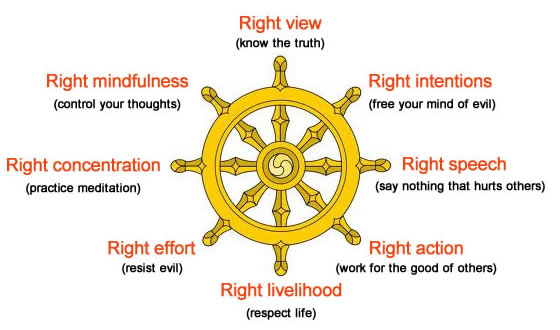
This post focuses on the 'ins and outs' of the noble eightfold path, also called 'The middle path'. Last weeks post on the four noble truths touched on it briefly, but hopefully this one will give you a better insight into what the eightfold path is, what its made up of and how it can help you.

Despite its name, the eightfold path isn't meant to be followed, like a step-by-step guide. All of the right elements should be adhered to and worked on simultaneously, as none of them are any more important than another. They all bind together and form a powerful way for Buddhists to better themselves.

Of course, as with all of the Buddha's teachings, do not follow it blindly. Such an attitude will leave you dissatisfied, and with a result you maybe weren't seeking. Learn what works your own way, and forge your own path. I can guarantee you'll be happier that way.

The word 'right' is used at the beginning of each element, and in these instances means an ethical, balanced and middle way. The path can be broken down into three parts. Wisdom, Morality and Concentration.

So with further delay, like all good things, let's start at number one!

Right View (Sammā ditthi)

Right understanding, also called 'right understanding', refers to our perception of the world around us. This is a crucial step on the path as it reminds us to try and view the world as it really is, not as we'd like it to be. It's important to find that fine line between pessimism and optimism (a middle line, some might say!) and focus on reality; more specifically, the reality of suffering.

Right view is the first point on the path because the right view of the world is needed before you can truly act on it, and start making the changes that you require to make.

Right Intention (Sammā san̄kappa)

Next up is having the right intention. San̄kappa translates purpose and motivation. It follows on naturally from having the right view. You need to have the right attitude to go with that view. It's the step where we truly become dedicated to the eightfold path and start acting based on what we truly, as human beings, desire.  Right view gives us the equipment and the know how to adopt the middle way, right intention is the motivation to really get out there and do it! With the right understanding and right view, we remove desire. Which makes the path to the cessation of suffering so much easier.

Right Speech (Sammā vācā)

Now, this one probably explains itself pretty well already. Almost as though as general rule in today's society, we forget the power of the spoken word. Something which one might view as a harmless joke or a bit of fun, can cause such devastating damage in someone's life and to their self esteem that it's painful to even think about the effects it's had on people in the past, in some cases causing them to self-harm or even take their own life.

The element of 'right speech' encourages the use of speech in a positive manner. Not through harsh criticism or jabs at the way people look, but by lifting people's spirits and bringing compassion through communication. You'd be amazed at how much you can brighten someone's day just by complimenting them or saying something positive about them. If we all watched our speech a little closer, there'd be many more smiles on many more faces throughout the world.

Right Action (Sammā Kammanta)

Right action, also called right conduct, purely involves how you act to others, yourself and the world around you. As I mentioned above, your words can heavily impact someone's life, and that goes just as much (in some cases more) for actions. You, as a human being, can so easily cause damaging and suffering, and it's up to you to control your actions and let others and yourself benefit from the results.

Right action can be broken down into three sections.
The first of which, is to abstain from the taking of sentient life. This includes human beings and animals, even down to the tiniest of insects. However that's a broader topic that I'll delve into another week.
The second is to abstain from stealing, which also takes the forms of cheating and gaining any wealth through dishonest means.
The third is to abstain from sexual misconduct. This is also a broader topic that I'd like to discuss at a later date, so I'll leave it untouched for now.

Right Livelihood (Sammā ājīva)

The Buddha taught that anyone who earns their livelihood through unwholesome means that cause harm or suffering will eventually lead to that person's own inner deterioration. This includes, but in not necessarily limited to:

-Butchering
-Arms dealing
-Slave trade
-Prostitution
-Drug dealing (including alcohol)

Right Livelihood can also relate back to the second section of right action: stealing. If one earns their living through dishonest means and trickery then it would compromise both right livelihood and right action. This is an example of how all of the eight elements are interconnected.

Right Effort (Sammā Vāyāma)

This element of the eightfold path, on a basic level, is all about avoiding negative thoughts and emotions such as anger and jealousy. You should try your best to cultivate an enthusiastic approach towards life, in a balanced and wholesome way. Of course, realistically, this isn't always possible. People can make us angry and jealous without us meaning to be. But the point is to try. Try to become a force for good in the world by adopting the right motivation and effort to achieve what you want to achieve.

Right Mindfulness (Sammā sati)

Right mindfulness is probably the most difficult of the eight elements to grasp. Right mindfulness is what I'd consider a 'Zen' concept. It's about being focused in on the moment, on the here and now. Truly listen to the noises going on around you, focus on all the sights, smells, tastes and sensations, and hone in on those sensations. Be focused and aware.

Mindfulness and mediation is often viewed as trying to close off the world around you, and shut yourself inside your own mind. When in fact, it's the opposite. You're becoming more aware. You're slotting yourself into the world around you and becoming a part of the environment.

Right Concentration (Sammā samādhi)

Right concentration is all about using meditation to reach the highest level of enlightenment possible. Both this, and Right Mindfulness are about unifying the mind and developing one single, disciplined concentration. Once the mind is free of clutter, it is then easier for us to achieve what we desire. Right concentration is focusing the mind on a single point, an object or idea, and forms the initial stages of the meditation process.

Conclusion

And that's the essence of the eightfold path. As long as you study these eight points as a single behaviour, and not as separate steps in a path, you'll reap the benefits of it immediately. When the mind is so focused on being more compassionate, aware and awakened, it will have no choice but to become so.